Maturity Model
Introduction
Maturity is a self-evaluation process conducted by the team. ODEF provides guidance and structure and assures that all the relevant areas are covered. The goal of the review process is to give a baseline that helps achieving a common understanding about the organization security posture.
Dimensions
- Threat Detection Content
- Assurance
- Knowledge sharing
flowchart RL
    Assurance(Assurance) <--->Threat[Threat Detection Content]
    Knowledge[Knowledge sharing] <---> Assurance(Assurance)
    Knowledge[Knowledge sharing] <---> Threat(Threat Detection Content)
Maturity levels
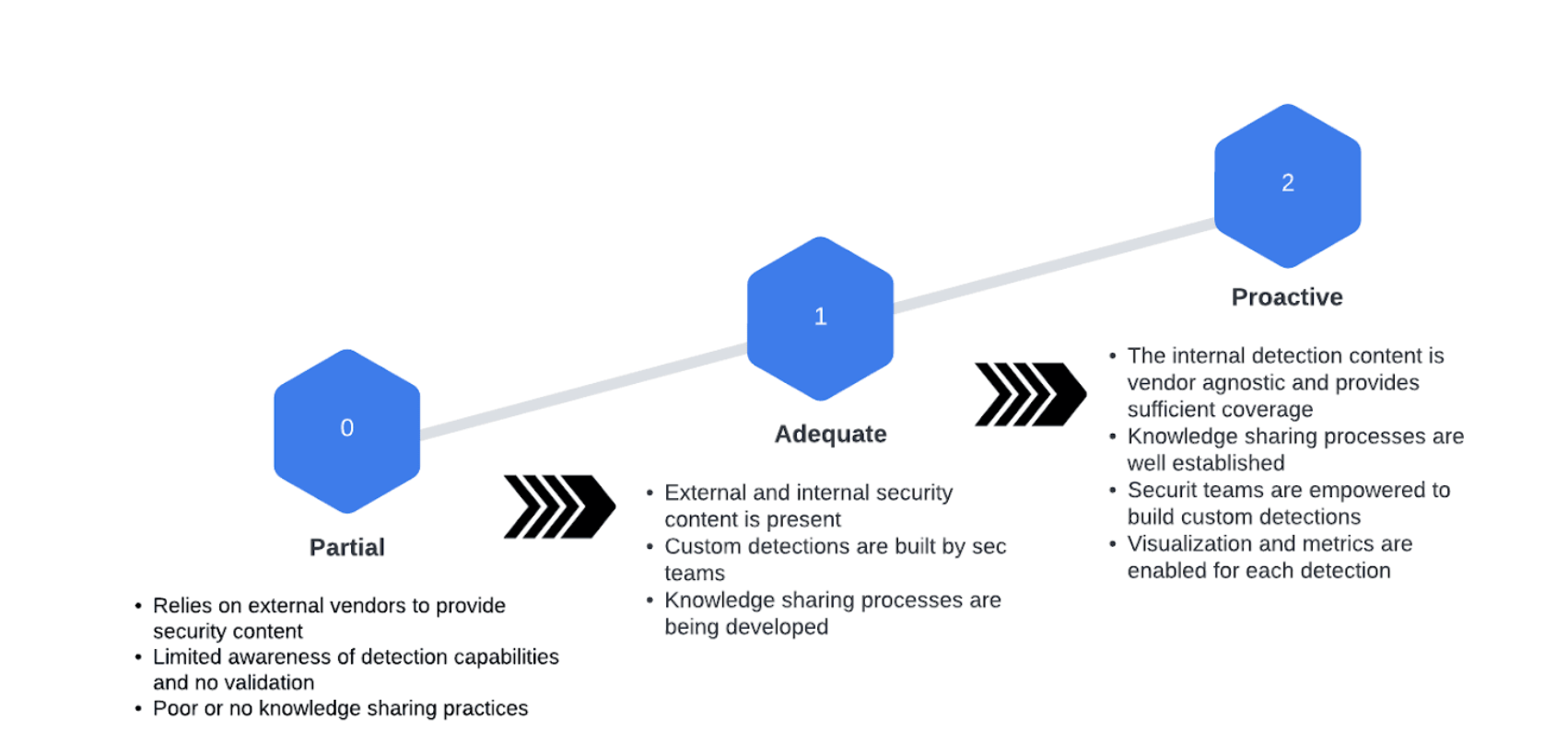
Level 1 - Partial
- Threat Detection Content
- Organizational threat identification practices rely solely on external vendors to provide security content.
- Assurance and context around alerts and detections is not provided or sufficient.
- Risk is managed in an ad hoc and often reactive manner by relying on third parties.
- Assurance
- There is some limited awareness of cybersecurity threat detection capabilities at the organizational level.
- The organization implements threat validation and verification on an irregular, case-by-case basis due to varied experience or information gained from outside sources.
- Assurance through continuous validation is not present.
- Knowledge sharing
- The organization may not have processes to enable cybersecurity information sharing.
- Documentation is rarely written and shared only on ad-hoc basis and it is scattered across teams.
Level 2 - Adequate
- Threat Detection Content
- Organizational threat identification practices rely on internal teams and external vendors to provide security content.
- Context around alerts and detections is provided. Specialized teams are able to introduce new detections and security content.
- Some security teams have a better understanding of security posture than others.
- Assurance
- There is some awareness of cybersecurity threat detection capabilities as the organization is now building custom detections to compensate for gaps.
- The custom detections are use case driven and validated during the detection development process.
- Continuous validation is not enabled and the organization still relies on suppliers for most of the detection capabilities.
- Knowledge sharing
- The organization is starting to enable knowledge sharing and promotes documentation efforts.
- There is a central detection information repository.
Level 3 - Enabled (Proactive)
- Threat Detection Content
- Organization maintains continuous practices that provide excellent internal insights and knowledge. Context around alerts and detections is provided.
- Any team is encouraged and capable to introduce new detection components and thus improve the security posture.
- The security posture of the environment is well understood across the security teams.
- Assurance
- The organization possesses a detection coverage map and covers a big percentage with in-house built detections. The organization does not rely on vendors to provide security content.
- Automation is provided to continuously validate and run the detection use cases.
- Additional assurance is achieved by running red team exercises and automation frameworks.
- Knowledge sharing
- Organizations possess practices to create and maintain high quality records and appropriately control and manage the access to the information.
- Processes for socializing detections are automated and teams are informed of the development of new detections.