The Framework
Chapter 1
Open Detection Engineering Framework
A detection engineering story
A detection engineering story
ODEF enables organizations to establish and apply fundamental principles and best practices in detection engineering. Adopting ODEF accelerates service enhancement, refines processes, and advances cybersecurity maturity.
The framework strategically aligns cybersecurity efforts with business objectives (e.g., risk reduction and operational resilience). It enables the creation of robust detection systems, provides assurance, reduces reliance on vendors, and, most importantly, strengthens an organization’s overall security stance. ODEF defines core principles for effective detection engineering and introduces a three-tiered maturity model to evaluate organizational performance.
Each phase within the framework’s core is meticulously crafted to map out the detection lifecycle, guiding detection engineers with focused functions and outcomes expectations that steer them through the entire process. The maturity levels act as strategic benchmarks, providing organizations with a high-level perspective on their detection engineering strategy and highlighting areas for potential improvement.
The overarching ambitions of the framework are to:
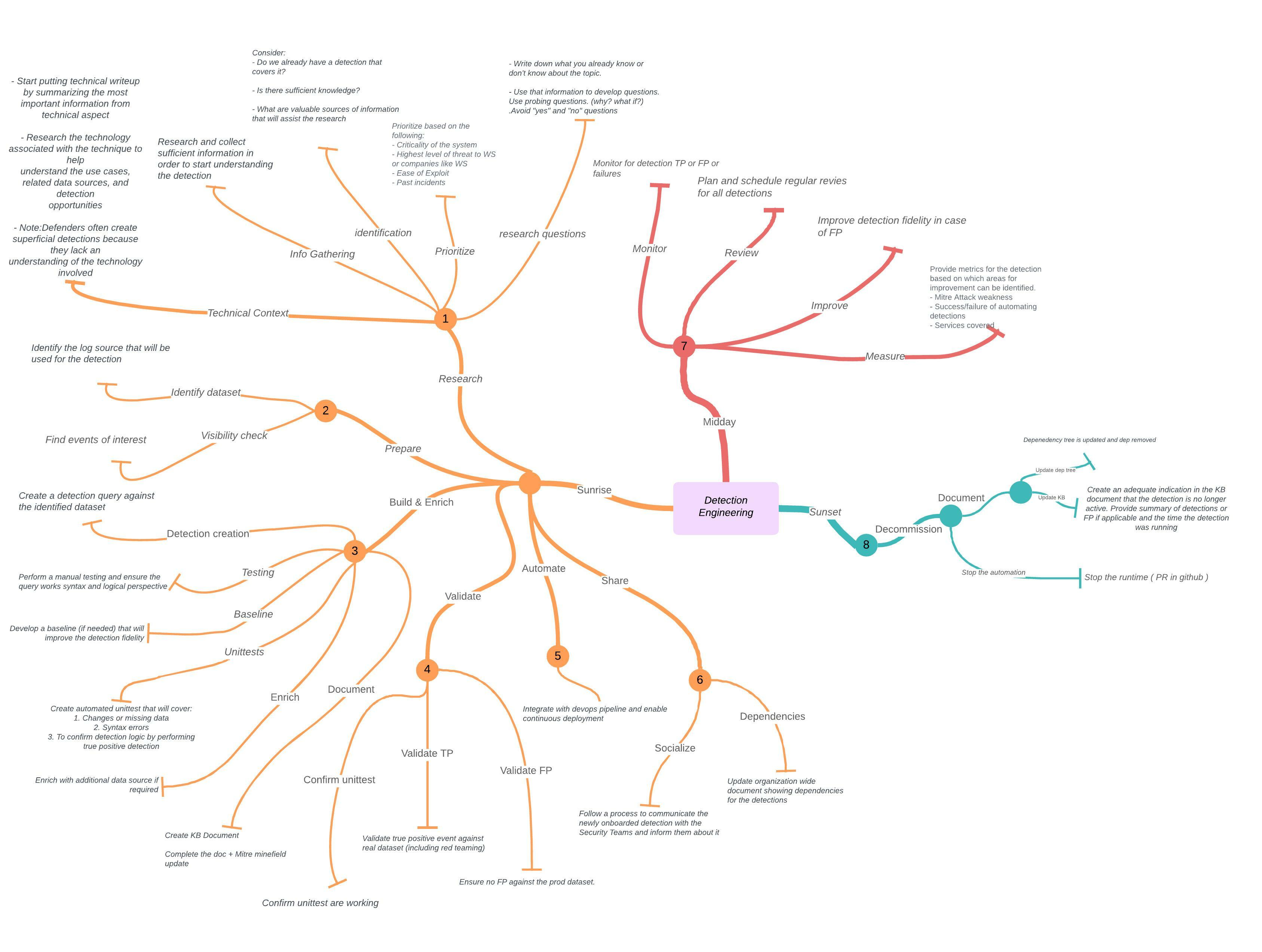
The Framework Core is a suite of activities aimed at achieving specific cybersecurity objectives, supplemented by illustrative examples to guide their implementation. The Core is structured around three lifecycle phases: Sunrise, Midday, and Sunset which holistically cover the detection lifecycle from inception to completion, with dedicated functions, guidelines, and goals for each phase. Together, these components provide detection engineers with a “north star” focus, enabling them to deliver high-quality detections with precision.
Each phase of the detection lifecycle is defined by specific functions, goals, and guidelines. These elements work together to guide detection engineers in producing robust, reliable detections
Inspired by the single-responsibility principle from software engineering, each function in ODEF represents a discrete step with a singular focus and outcome within the detection lifecycle. These single-goal activities are designed to drive a specific activity, ensuring clarity and precision at every stage.
Each function is crafted to achieve a specific, well-defined result that aligns with the overarching objectives of the detection lifecycle. While goals may sometimes be high-level or abstract, it is strongly recommended to maintain a direct correlation between functions and goals. This alignment ensures that each function contributes meaningfully toward the end goal, enhancing both focus and quality in detection engineering.
Guidelines act as reference materials that support the achievement of goals within each function. They provide detection engineers with context-specific insights and best practices, helping to standardize processes while allowing adaptability. For example, a document detailing a company’s unique Change Management process would serve as a valuable guideline
The Core encompasses three primary lifecycle phases:
These phases collectively chronicle the lifespan of a detection mechanism, from its conception to its eventual retirement/decommissioning.
In the rhythm of each day lies the strength of progress; every sunrise brings new potential, midday illuminates our purpose, and sunset reminds us to refine and renew.
Sunrise is the first phase of the detection lifecycle. It marks the inception, development and deployment of the detection. During that phase there are 6 core functions that should be addressed:
| Functions | Goal | Description | Guidelines |
|---|---|---|---|
| Research | Opportunity Identification | It can be triggered from analyzing threat intelligence reports, or OSINT, or internal knowledge for a particular security gap. Document the use case and the goals of the detection as part of the opportunity identification process. |
|
| Prioritize | Detection engineering work has to be prioritized and tracked. Work prioritization can be based on urgency and priority. Backlog of detections and security posture activities is desirable and recommended. | Prioritization criteria:
| |
| Develop Research Questions | Write your research questions that while answering you will gain understanding of the topic. | Examples:
| |
| Information Gathering | Research and collect sufficient information in order to start understanding the detection | Provides a good overview of the topic if you are unfamiliar with it.
| |
| Technical Context | Create and understand technical context around the detection |
| |
| Prepare | Identify Dataset | Identify the log source that will be used for the detection | Know your environment
|
| Visibility Check | Ensure there is sufficient logging, retention and visibility in order to successfully build the detection and satisfy the use case |
| |
| Improve (optional) | Once the data is explored we can identify opportunities for improvements such as:
| Improvement initiatives and requests should be communicated to the responsible for the dataset in question team. For that purpose it makes sense to maintain a contact list that provides quick reference to technology, support/engineering teams and contact details. | |
| Build & Enrich | Detection Creation | Create a detection query against the identified dataset | Having a good understanding of the technical context and the data source begin building queries to narrow down the data to actionable insight. |
| Manual Testing | Perform a manual testing and ensure the query works syntax and logical perspective |
| |
| Baseline development | Develop a baseline (if needed) that will improve the detection fidelity |
| |
| Unittest Development | The unittest development is dependent on the type of devops pipeline. Simple goals are provided. | Goals for the unittesting:
| |
| Enrich | Enrich with additional data source if required |
| |
| Document |
|
| |
| Validate | Confirm unittests | Confirm unittest are working | Confirmation of the unittests can be done by inspecting the implemented devops pipeline and ensuring that the actions (in the case of github) for unittests are running |
| True Positive validation | Validate true positive event against real dataset using the query developed earlier. | True positive validation can be achieved by:
| |
| False Positive Validation | Ensure no FP are produced by the query when ran against the prod dataset. |
| |
| Automate | Automation & deployment | This step is entirely dependent on the environment and should follow the standard ci/cd or automation practices of the organization. | Integrate with devops pipeline and enable continuous deployment |
| Share | Socialize the new detection | A notification process is required and it should be created. The process can be in the form of newsletter or slack channel notification, preferably automated one. | Follow a process to communicate the newly created detection with the Security Teams and inform them about it |
| Update Sec Dependency Tree | This document is actually part of the repository and can be shared with data engineering and security teams. The goal of sharing it is to promote care mentality where teams would check before they change. Meaning, if data engineer is about to rename an index they should first check if the index is being used. Having dependency document as part of the repository makes it easy and seamless for them to check. | Update organization wide document showing dependencies for the detections |
graph TD;
Research1(Opportunity Identification) -->Research2(Prioritize);
Research2 -->Research3(Develop Research Questions);
Research3 -->Research4(Information Gathering);
Research4 -->Research5(Collect Technical Context);
Research5 -->Prepare1(Identify Dataset);
Prepare1 -->Prepare2(Visibility Check);
Prepare2 -->Prepare3{Improve};
Prepare3 --> |yes| cis[Start security improvement initiative];
Prepare3 --> |no| Build1(Detection Query Creation);
Build1 --> Build2(Manual Testing);
Build2 --> Build3(Baseline development);
Build3 --> Build4(Automated Unittest Development);
Build4 -->Build5(Enrich);
Build5 --> Build6(Document);
Build6 -->  Validate1(Confirm unittests);
Validate1 -->val2(True/False Positive validation);
val2-->automate(Automation & deployment);
automate --> share(Socialize the new detection);
share -->share1(Update Sec Dependency Tree);
The “Midday” phase is normally the longest phase from the detection lifecycle, during which the detection has been engineered and commissioned to production. The phase monitors the detection during its operation and aims to improve it if needed. High level goals for the Midday phase:
| Functions | Goal | Description | Guidelines |
|---|---|---|---|
| Monitor | Run as per defined schedule | Detection is configured to run on pre-defined schedule or real time if applicable | Detections will run based on the schedule set during the sunrise phase. |
| Confirm unittest passing | Monitoring is configured to notify the responsible team in case the automation for the detection is not running properly | Suggested approach: github actions - before deployment ensuring proper syntax | |
| Work detections | Once detection is running it should be monitored for any TP or potential influx of FP | TP events should be triaged, investigated and responded on by following an agreed IR process. FP events should be investigated, proved as FP and documented as part of the baseline. Once the baseline is changed in the documentation the query can be updated and improved. | |
| Measure | Measure detection efficacy | Enable metrics for the detection based on which areas for improvement can be identified. Mitre Attack weakness Success/failure of automating detections Services covered | Each detection that covers particular TTP can be marked in the Mitre ATT&CK Navigator. Looking at percentage of covered tactics and techniques can be a metric. Success or Failure in detection automation or influx of FP metric can be used to identify detections that require improvement. Detection runtime length is a metric which can identify poorly written queries. For example, query too open that collects way too many events and chunks too much data only to spend even more time to filter by using custom logic. |
| Improve (optional) | Improve detection fidelity | Once improvement opportunities have been identified during the operations or periodic review an improvement is triggered | The goal of this function is to improve any detections which are with poor health (slow runtime, causing errors) and improve them by revisiting the detection logic. |
| Review | Perform periodic review | Review detections to identify improvement opportunities or decommission requirements | Detection can become irrelevant and thus decommissioned when: The risk that it is compensating is far smaller than the cost of running the detection The technology used for the detection is no longer present in the company |
graph TD;
Monitor1(Run per schedule) -->Monitor2(Receive and respond to alerts);
Monitor2 --> Monitor3{False Positives?} ;
Monitor3 --> |no| Measure[Document TP];
Measure --> Review(Perform periodic review)
Monitor3 --> |yes| Improve(Improve);
Improve --> Monitor1;
During the “Sunset” phase the detection is taken out of commission. The phase wants to ensure that resources are not spent for outdated detections that are no longer applicable and at the same time leave sufficient trace of the existence of the detection.
High level goals for the Sunset phase:
| Functions | Goal | Description | Guidelines |
|---|---|---|---|
| Decommission | Decommission the detection | The goal is to decommission the detection by following process that provides visibility | In order to decommission a detection simply change the status field to "Sunset" in the .yml file. Assuming your devops pipeline is configured correctly, this should effectively disable the detections and prevent it from running. Note: Do not remove anything from the repository as detections can be reused in future. |
| Knowledge base update | Create an adequate indication in the KB document that the detection is no longer active and socialize the change with your security teams. | Update Mitre coverage map by removing the coverage that the detection was providing |
graph TD;
Review1[Review completed] --> Review2;
Review2{detection ready to decom} -->|no| End[end];
Review2{detection ready to decom} -->|yes| Preserve(Preserve knowledge);
Preserve --> Decommission(Decommission the detection);